
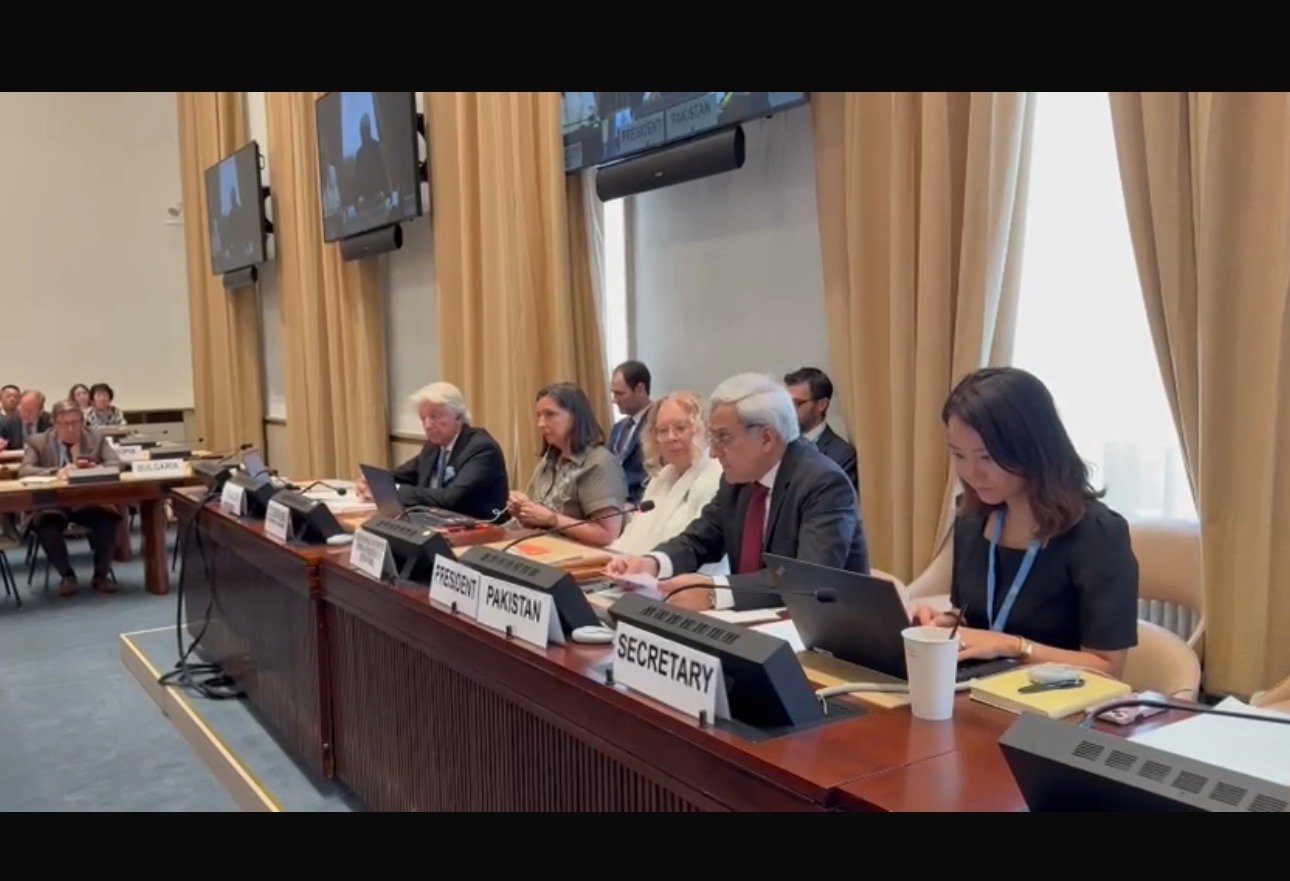
GENEVA: President of the Conference on Disarmament (CD) Tahir Hussain Andrabi has said the world has become more dangerous due to growing armed conflicts, weakening arms-control agreements and rapid advances in emerging technologies, making the forum more necessary than ever.
Addressing the Conference on Disarmament, Mr Andrabi said it was a unique honour for Pakistan to assume the final presidency of the CD’s 2026 session.
He also described his return to the conference as a personal honour, recalling that he had served as Pakistan’s Deputy Permanent Representative to the Conference on Disarmament from 2017 to 2021.
“Although much has changed outside this chamber, the circumstances facing the Conference on Disarmament remain largely the same,” he said.
Mr Andrabi said that when he left Geneva five years ago, the international security environment was already under considerable pressure. However, developments over the past few years had deteriorated in ways that few could have predicted at the time.
He pointed to the spread of armed conflicts in different regions, the weakening or suspension of major arms-control agreements and initiatives, the modernisation and expansion of weapons stockpiles and changes in defence doctrines.
He also highlighted rapid technological developments in space, cyberspace and artificial intelligence, which, he said, were advancing faster than the existing frameworks designed to regulate them.
“Trust among major powers has reached its lowest level in decades,” Mr Andrabi said, warning that the international security environment had become increasingly dangerous.
He argued that the long stalemate at the Conference on Disarmament could not simply be attributed to its procedures, rules of conduct, consensus principle or working methods.
“The real problem is not the procedure of the Conference,” he said.
Mr Andrabi noted that the Conference on Disarmament and its predecessor bodies had successfully negotiated major historic international security treaties and instruments while operating under largely similar rules.
“The procedure that delivered these important achievements in the past has not become ineffective,” he said.
Using an analogy, he said if passengers on a bus could not agree on their destination or route, the problem was not with the bus.
He said the Conference had served as a vehicle for the international community to reach important destinations in the past and could do so again if all parties demonstrated the necessary political will.
Mr Andrabi also urged delegates to consider what the international community would do if the Conference did not exist.
He said establishing a new comprehensive forum capable of bringing all major military powers together on a single platform, under agreed rules and drawing upon decades of accumulated experience and expertise, would be extremely difficult.
At the same time, he called for a realistic assessment of the Conference’s performance.
“We must openly acknowledge our inadequate performance over the past years,” he said, pointing out that no legally binding treaty or legal instrument had been negotiated at the forum for nearly three decades.
However, he stressed that realism should not mean pessimism or withdrawal.
“Even in the absence of negotiations, this Conference can and should undertake meaningful and substantive work,” he said.
Mr Andrabi referred to the experience of subsidiary bodies established in 2018, 2022, 2024 and 2025, saying they had demonstrated that focused and structured discussions on various agenda items were possible.
Such discussions, he said, enabled experts to contribute, improved understanding of technical issues, helped identify areas of convergence and allowed a negotiating environment to be maintained.
Although the Conference failed this year to agree on the establishment of subsidiary bodies, it had nevertheless continued meaningful and substantive discussions on different agenda items, he said.
He stressed that the Conference would need to continuously assess how it could be used more effectively and realistically in the future.
“We must maintain meaningful work and practical progress even in years when consensus on decisions cannot be achieved,” Mr Andrabi said.
He said the Conference’s primary responsibility was to prepare its annual report for the United Nations General Assembly.
The draft report would be issued by the secretariat after the conclusion of the session, he said, adding that it would be formally presented at a plenary meeting the following day.
The annual report is the key document that the Conference is required to submit to the General Assembly every year, even when it fails to reach agreement on other decisions.
Mr Andrabi called on all delegations to extend their cooperation and demonstrate a constructive spirit and flexibility to ensure that the annual report could be adopted by consensus and within the required timeframe.
“The doors of the Conference will remain open to every delegation,” he said, adding that he and his team looked forward to working closely with all delegations through consultation and cooperation.


Comments (0)
Leave a Comment