
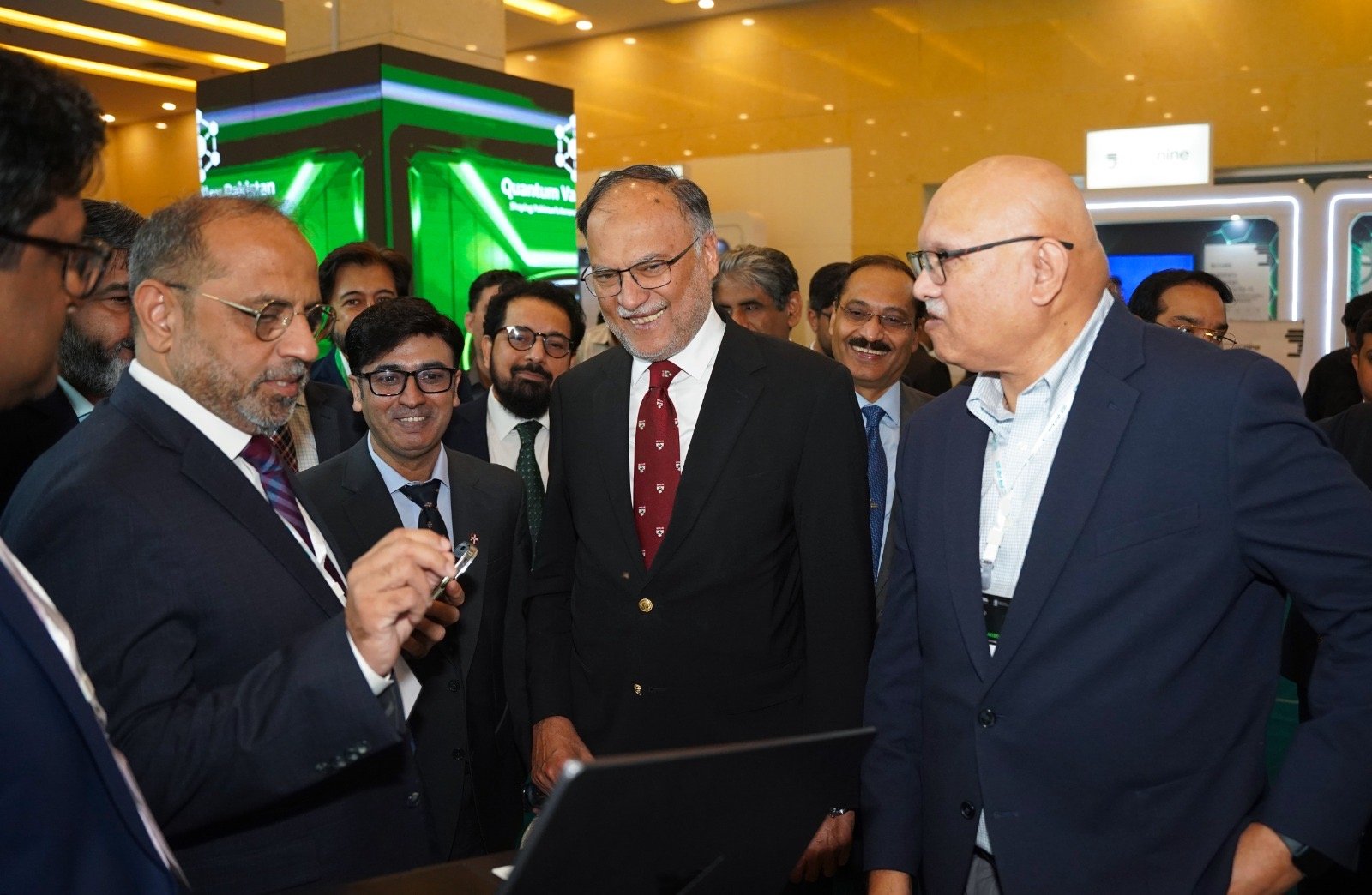
ISLAMABAD, Sept 16, 2026: Federal Minister for Planning, Development and Special Initiatives Ahsan Iqbal on Wednesday launched Quantum Valley Pakistan, an initiative aimed at transforming research and innovation into commercial products, startups and global exports.
Speaking at the launch ceremony, Iqbal said the initiative marked “the beginning of a new direction for Pakistan’s future” by connecting universities, researchers, startups, industry, investors and international technology ecosystems.
He said Pakistan’s young population represented a major source of talent and called for a “Team Pakistan” approach to turn innovative ideas into globally competitive businesses.
Two agreements were signed at the ceremony between Cambridge Innovation Centre (CIC) and Quantum Valley Pakistan, and Plug and Play and Quantum Valley Pakistan. International delegates included CIC CEO Tim Rowe, CIC Partner Dougan Sherwood and Plug and Play Managing Partner Seena Amidi.
Under the Global Cohort Competition, 60 Pakistani ventures will be selected for international acceleration programmes. Thirty startups will be linked with Plug and Play in Silicon Valley, while another 30 will join the CIC programme in Massachusetts.
The proposed innovation district will feature four science parks focusing on mines and minerals, agri-tech, biosciences and emerging technologies. It will also establish a national network of nine specialised catapults offering pilot lines, fabrication facilities, technology testing, certification support and specialist training.
The catapult model is designed to help technologies progress from proof-of-concept to pre-commercial readiness, addressing a major gap faced by startups seeking to commercialise research.
The initiative will focus on emerging fields including quantum computing, artificial intelligence, robotics, photonics, advanced materials, agri-tech, biosciences, minerals and advanced manufacturing.
Potential applications include quantum cybersecurity, medical diagnostics, mineral exploration, climate monitoring, precision agriculture, water conservation, energy efficiency and digital manufacturing.
Iqbal said Pakistan needed to increase exports and build a technology-driven economy, noting the government’s target of transforming the country into a $1 trillion economy by 2035 and a $3 trillion economy by 2047.
He stressed that the success of the new technology ecosystem would be measured not only through research papers but also through patents, technology transfers, prototypes, startups, investment, employment and exports.
The project draws on international innovation models, including experience from St John’s Innovation Centre in Cambridge, which conducted the feasibility study and contributed to the proposed institutional structure for Quantum Valley Pakistan.






Comments (0)
Leave a Comment